|
Viktor‘s Notes for the Neurosurgery Resident ISSN 2029-2538
Designed for early-career neurosurgeons, neurosurgery residents and aspiring medical students who need fast information retrieval
Hearts and Prayers for Ukraine! Ukraine, you are not walking alone! Україно, ти крокуєш не одна!
The new (2022) condensed section
>> tailored to assist early-career neurosurgeons with ABNS (American Board of
Neurological Surgery) oral exam preparation.
Viktor’s Notessm for the Neurosurgery Resident include: 1. Neurosurgery 2. Neurology 3. Ophthalmology 4. Otology 5. Psychiatry & Behavioral Science 6. Basic Sciences (anatomy, histology, physiology,
embryology) of Nervous System, Ear, and Eye. 7. Selected Relevant Topics from Other Medical Fields (e.g., diabetic
neurology, neurologic aspects of AIDS, neurogenic bladder, surgical infection,
hemostatic agents in surgery, hypertensive encephalopathy, coronary artery
disease, pituitary disorders). If
you feel that additional topics could be important for the neurosurgery
resident and thus should be included into Viktor’s Notessm for the Neurosurgery Resident, then please do
the following: 1) check if the topic
is not already in the chapter “Other Relevant Topics” >> 2) if the topic is
not there, feel free to contact the Editor >>
The “online notes”
format is based on the following features that are implemented into Viktor’s Notessm to facilitate fast information retrieval: 1. Text is divided
into logical items under headings and
subheadings. 2. Plain text is
converted into tables, text boxes, and
lists wherever possible. 3. Text is richly formatted with different font
styles, colors, sizes, and highlightings. 4. Arbitrary signs and symbols are used (e.g., “ → ” means “following action” or “result / consequence”;
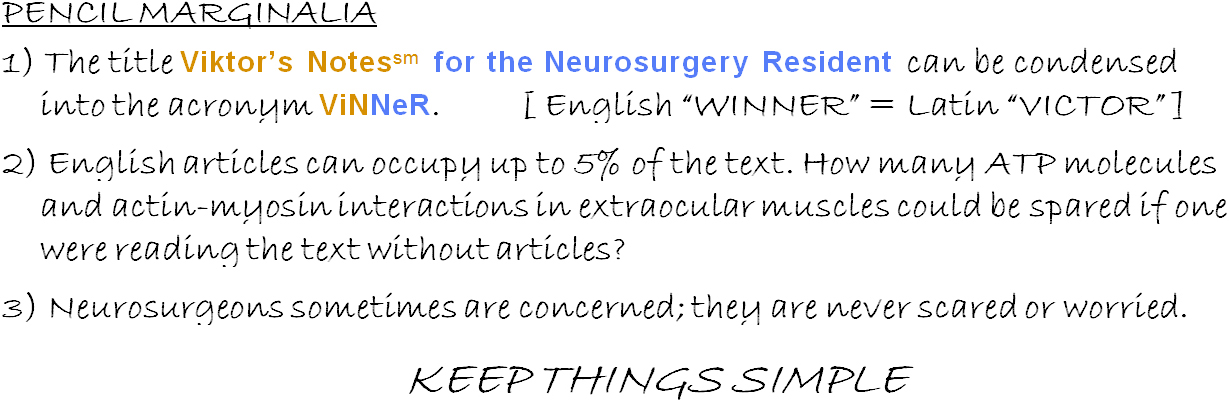
“ H: ” means “helpful solution”). 5. Language is simplified – articles (the, a, an)
are deliberately removed from the text by text processing software.2) 6. Meaningful prefixes are assigned to page
numbers. 7. Cross-references and Hyperlinks are easily
visible because of the distinct 40% grey color and
accompanying “double arrowhead” (e.g., this is link
>>); terms
see below and see above are used
when the referenced item is on the same article. 8. All pages have a
string “Last updated:” indicating
the date of the most recent content revision. 9. Finally, text is
edited to be as concise as possible
without sacrificing any important information.
Updated: May 20, 2023 |
||||||||||